Who can still believe that Romney is a fiscal conservative?
Take 1:
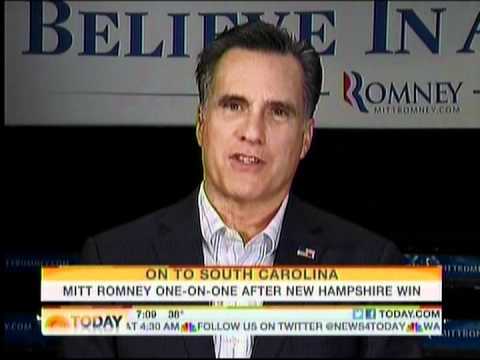
you have a president encouraging the idea of dividing America based on the 99 percent versus one percent — and those people who have been most successful will be in the one percent — you have opened up a whole new wave of approach in this country which is entirely inconsistent with the concept of one nation under God. – Mitt Romney
This was a representation of those on the right who have a problem with the president speaking of Americans in classes of people, and pitting them against each other. Many conservatives lean toward a flat tax or a fair tax rather than the progressive tax that penalizes those who create wealth in order to redistribute their property to those who haven’t been creating wealth.
Obama had previously proposed in his “Jobs Bill” limiting deductions on the wealthiest Americans, which would result in fewer donations to charities, and would in effect be a war on non-government charities. The idea is consistent with Obama’s perspective that government is the answer to every problem. He’s simply working on putting charities out of business. First with the “Jobs Bill” reducing contributions, now restricting the exercise of religion on employers.
In addition to dividing Americans into classes, many conservatives object to the language of people paying their “fair share.” The questions are significant: Who decides my fair share? What is “fair”? Why is my “fair share” different than someone else’s? In America, do we even have shares to pay?
Take 2: Today Romney announced his newest tax plan: Drop everyone’s tax rates except for the 1%, who need to pay their fair share:
Romney said his plan to limit mortgage interest and charitable contributions deductions would not impact middle income families. Instead, he noted, he wants to “make sure the top 1 percent keeps paying the current share they’re paying or more.”
Romney’s plan is everything he criticizes in Obama: Dividing Americans, and picking and choosing who to penalize because they aren’t paying their Fair Share.
Romney simply declared today that he is ” encouraging the idea of dividing America based on the 99 percent versus one percent — and … entirely inconsistent with the concept of one nation under God”
We have a liberal, 2 conservatives, and a libertarian running for the Republican nomination. Gingrich continues to lose steam, but will make a great advocate for conservatism. Vote Santorum.


 here is a strange idea abroad that in every subject the ancient books should be read only by the professionals, and that the amateur should content himself with the modern books. Thus I have found as a tutor in English Literature that if the average student wants to find out something about Platonism, the very last thing he thinks of doing is to take a translation of Plato off the library shelf and read the Symposium. He would rather read some dreary modern book ten times as long, all about “isms” and influences and only once in twelve pages telling him what Plato actually said. The error is rather an amiable one, for it springs from humility. The student is half afraid to meet one of the great philosophers face to face. He feels himself inadequate and thinks he will not understand him. But if he only knew, the great man, just because of his greatness, is much more intelligible than his modern commentator. The simplest student will be able to understand, if not all, yet a very great deal of what Plato said; but hardly anyone can understand some modern books on Platonism. It has always therefore been one of my main endeavours as a teacher to persuade the young that firsthand knowledge is not only more worth acquiring than secondhand knowledge, but is usually much easier and more delightful to acquire.
 This mistaken preference for the modern books and this shyness of the old ones is nowhere more rampant than in theology. Wherever you find a little study circle of Christian laity you can be almost certain that they are studying not St. Luke or St. Paul or St. Augustine or Thomas Aquinas or Hooker or Butler, but M. Berdyaev or M. Maritain or M. Niebuhr or Miss Sayers or even myself.